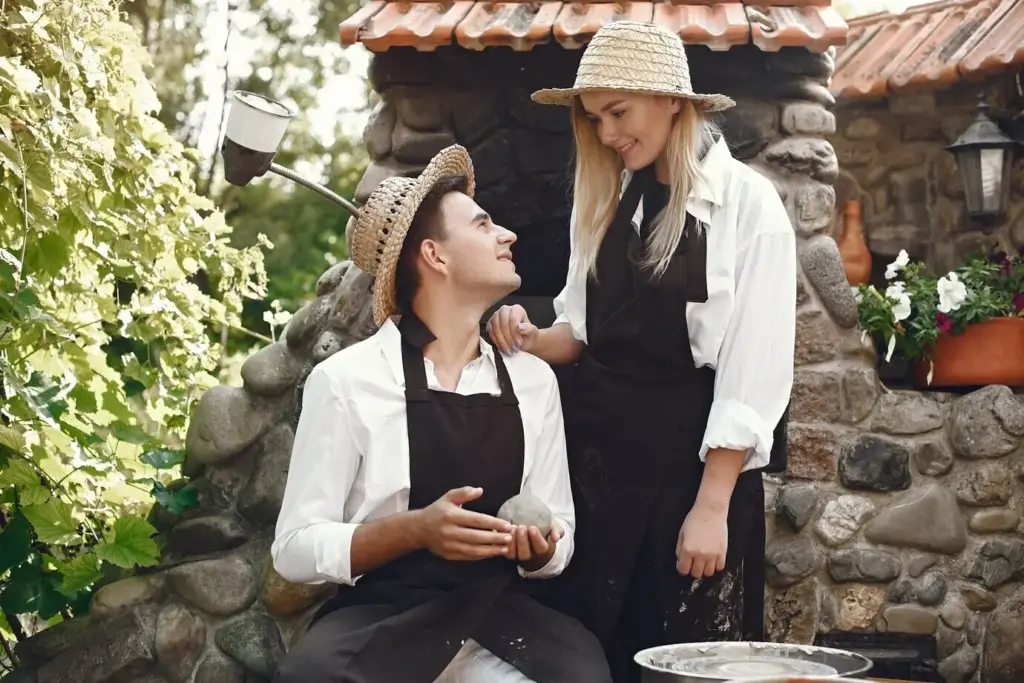
Throwing begins with wedged clay that feels alive, then centers with calm pressure until spinning mass becomes still in motion. Fingers establish base and wall thickness, ribs refine curves, and wires release forms for slow drying. Imperfections guide improvement rather than discourage effort. Each vessel records touch, speed, and moisture, carrying an imprint of the maker’s breath and patience that later glows beneath flame and ash.
Liquid clay slips add tonal layers and invite expressive trails. A polished stone burnishes surfaces into a soft sheen that later intensifies under heat. Sgraffito reveals contrasting colors through delicate carving, capturing wheat sheaves, stars, or simple lines that catch light at the table. Together, these time-tested techniques create depth without heavy glaze, leaving tactile surfaces that feel both refined and warmly familiar in everyday hands.
In Filovci, pots are fired and then smothered with sawdust and straw, starving flames of oxygen so smoke infuses clay. This reduction firing blackens surfaces beautifully and can enhance water resistance. The resulting sheen is not a coating but a transformation of the clay body itself, connecting each pot to fire’s mysterious chemistry and to makers who learned to read flames like a trusted, unpredictable teacher.
From Ribnica, peddlers once crossed passes with packs of sieves, spatulas, and rakes, trading practical wonders known as suha roba. Their routes stitched villages together, proving that craftsmanship travels as surely as news. Each sale funded another season in the workshop, another apprentice’s lessons, and another family’s table set with tools that worked hard, wore well, and returned value through kindness, reliability, and familiar touch.
Clay casseroles simmer jota and ričet steadily, distributing heat gently while preserving moisture and deep flavor. Unglazed interiors breathe, glazed exteriors wipe clean, and round shoulders retain warmth for shared meals. Wooden spoons protect surfaces and taste, stirring stews without metallic notes. These pairings, tested in countless kitchens, demonstrate how material choices shape recipes themselves, guiding techniques, timing, and texture as surely as spices and salt.
In Ribnica’s studios and Filovci’s yards, teachers guide with patient eyes and steady hands. Visitors try a first cut on linden, a first pull on the wheel, discovering how much expression resides in pressure and angle. Stories accompany technique, linking individual effort to regional history. Participants leave not just with projects, but with a sense of belonging to a wider circle of material literacy and care.
Responsible craft honors forests and soil. Makers choose locally felled timber from well-managed stands, salvage offcuts, and favor efficient drying. Clay is extracted carefully, with attention to restoring dig sites and minimizing waste. Kilns get upgraded for clean combustion and insulation, while finishes avoid harmful solvents. These practices protect the materials that make the work possible, aligning beauty with stewardship and the future with thoughtful hands.
We invite your stories about family spoons, blackened pots, or a treasured chest. Ask questions, request tutorials, and challenge assumptions kindly. Comment below, join our mailing list for workshop dates and behind-the-scenes notes, and share this page with friends who love making. Your voice keeps the conversation dynamic, helping traditions adapt without losing their heartbeat or the quiet friendships between hands, timber, clay, and time.
All Rights Reserved.